- About Us
-
 Secure, unlimited storage to ensures efficiency as well as high and continuous data access demand.
 Virtual server integration for 3D Rendering, AI or ML
 Enhance application capacity and availability.
 Access to an all-inclusive stack for AI development, driven by NVIDIA’s powerful technology!
 FPT Web Application Firewall provides powerful protection for web applications
 Advanced virtual server with rapid scalability
 Backup and restore data instantly, securely and maintain data integrity.
Advanced virtual server with rapid scalability
Access to an all-inclusive stack for AI development, driven by NVIDIA’s powerful technology!
Enhance application capacity and availability.
Backup and restore data instantly, securely and maintain data integrity.
Recovery, ensuring quick operation for the business after all incidents and disasters.
Backup and restore data instantly, securely and maintain data integrity.
Advanced virtual server with rapid scalability
Access to an all-inclusive stack for AI development, driven by NVIDIA’s powerful technology!
Enhance application capacity and availability.
Backup and restore data instantly, securely and maintain data integrity.
Recovery, ensuring quick operation for the business after all incidents and disasters.
 Diverse throughput and capacity to meet various business workloads.
Secure, unlimited storage to ensures efficiency as well as high and continuous data access demand.
FPT Web Application Firewall provides powerful protection for web applications
Intelligent and Comprehensive Virtual Web Application Firewall - Security Collaboration between FPT Cloud and Penta Security. Automatically detect misconfigurations and protect your FPT Cloud infrastructure – continuously, agentless.
The Next generation firewall security service
Automatically detect misconfigurations and protect your FPT Cloud infrastructure – continuously, agentless.
The Next generation firewall security service
Easily store, manage, deploy, and secure Container images
Safe, secure, stable, high-performance Kubernetes platform
Provided as a service to deploy, monitor, backup, restore, and scale MongoDB databases on cloud.
Provided as a service to deploy, monitor, backup, restore, and scale Redis databases on cloud.
Provided as a service to deploy, monitor, backup, restore, and scale PostgreSQL databases on cloud. System Monitoring Solution anywhere, anytime, anyplatform
 Helps reduce operational costs by up to 40% compared to traditional BI solutions, while improving efficiency through optimized resource usage and infrastructure scaling.
 - Pricing
- Partner
- Event
What’s New on FPT AI Factory
What’s New on FPT AI Factory
Table of Contents
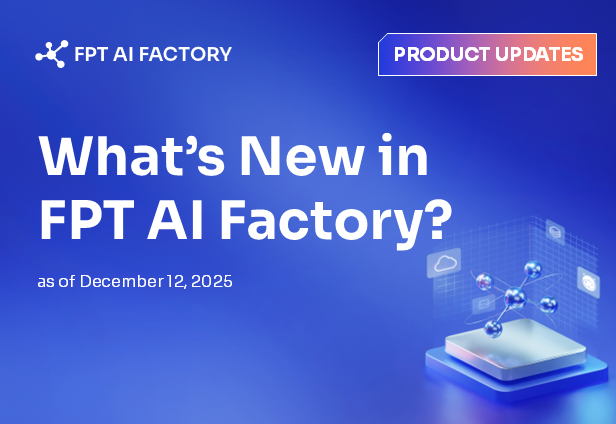
We continue to advance the FPT AI Factory platform to improve scalability, performance, and operational efficiency. This release, as of December 12, 2025, introduces new features and optimizations designed to enhance the smoothness and efficiency of your workflows.
FPT AI Studio
Accelerate LLM workflows with new optimization techniques and gain real-time visibility through Grafana-integrated UI Logs.
New feature
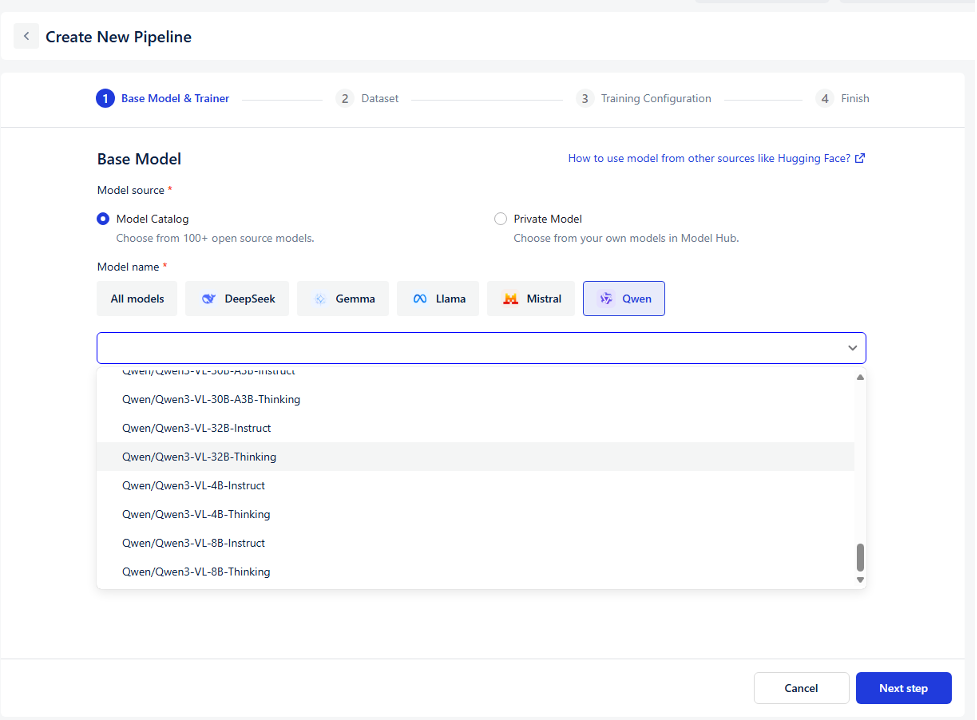
1. Full support for the Qwen3VL model
Allow users to leverage state-of-the-art multimodal capabilities of the Qwen3VL model family for tasks such as visual understanding across AI Studio and related services.
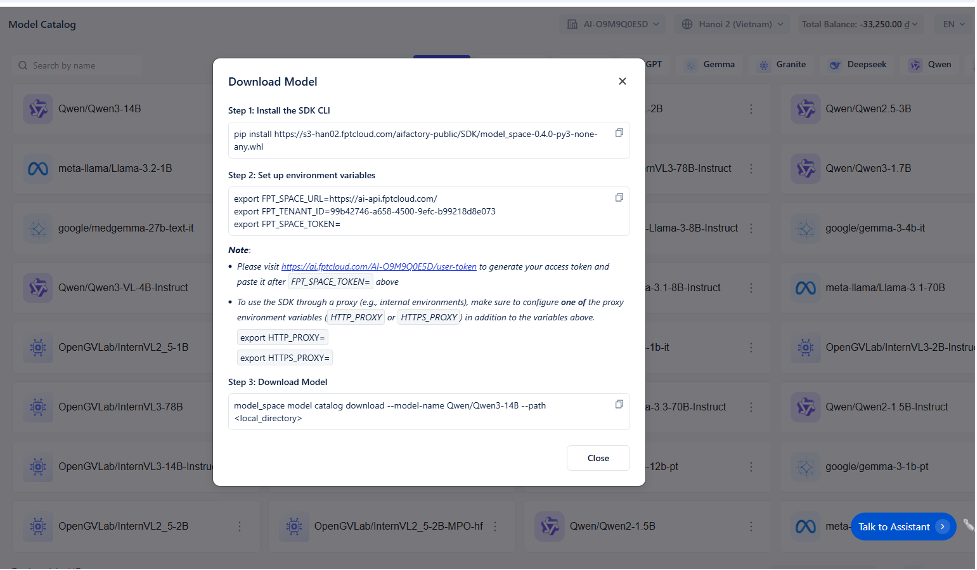
2. Support Download Model Catalog by SDK
Enable Model Catalog download via SDK gives developers a faster, automated way to integrate and manage models and improve workflow efficiency.
AI Notebook
Boost automation, ease of use, and performance, helping customers work faster and smarter with AI Notebook.
New feature
1. Automated Lab Version Upgrade
Remove manual steps for deleting old labs and remapping during version upgrades, saving time and reducing errors.
2. Event Notification Scheduling
Enable scheduled system and feature announcements directly in AI Notebook, ensuring users stay informed without disruption.
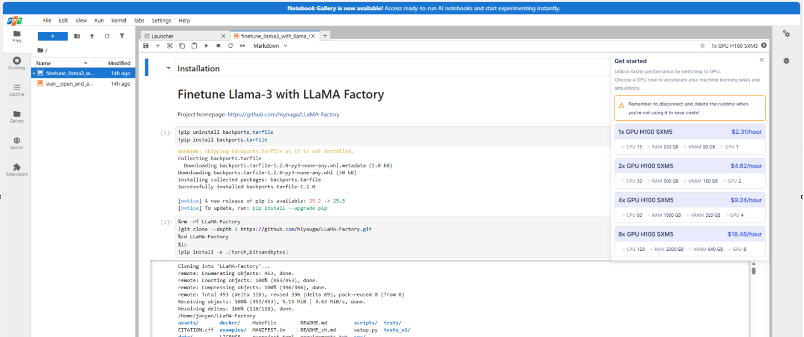
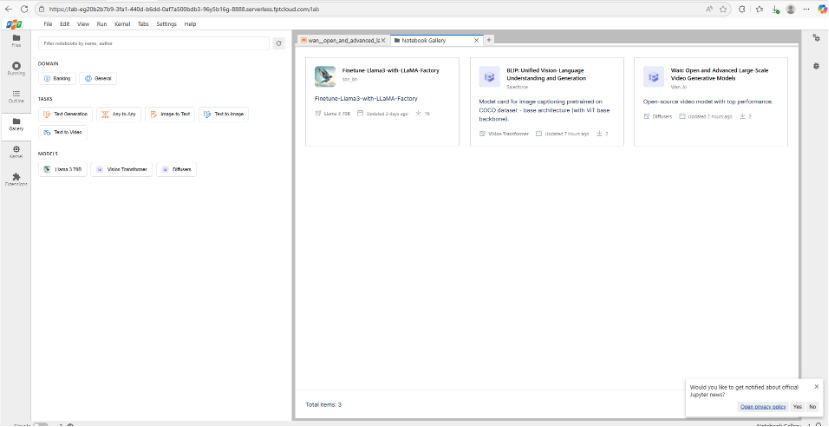
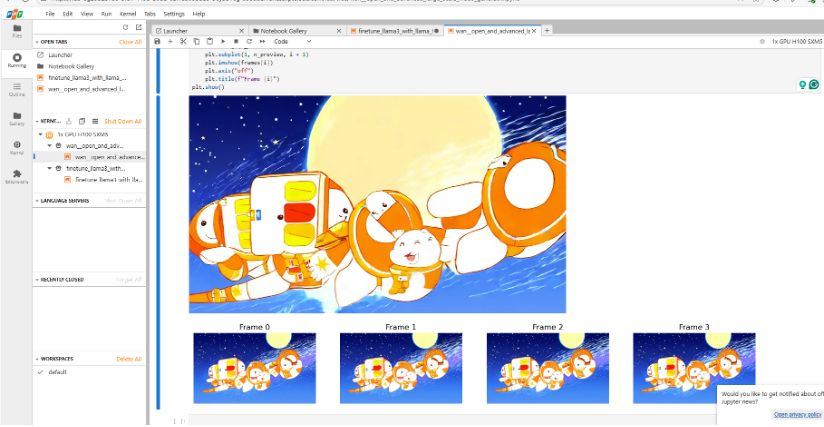
3. Notebook Gallery
Offer ready-to-use notebooks for common use cases across various topics, allowing quick reference and execution to accelerate development.
4. GPU Quota Control
Introduce per-tenant GPU usage limits for better resource allocation and cost management, ensuring fair and efficient utilization.
FPT AI Inference
Achieve operational stability with new upgrades in LiteLLM engine, billing, kafka, and top-up services.
New feature
1. Infrastructure & API Stability
- LiteLLM Upgrade: Enhance system resilience and processing efficiency with the upgraded LiteLLM architecture
- API Standardization: Ensure consistent data output and improved integration capabilities by optimizing and standardizing the v1/responses/ parameter.
2. Production Go-Live & Core Services
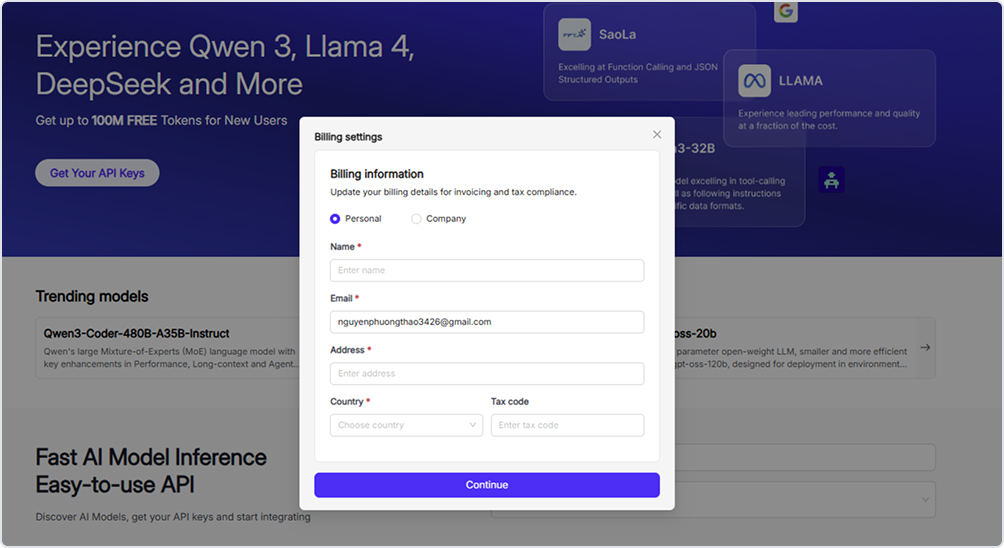
- Seamless Payments & Billing: Enjoy instant account top-ups and accurate, real-time service charge tracking.
- High-Performance Connectivity: Experience a faster, smoother platform with improved stability for real-time interactions.
- Enhanced User Feedback: Clearer interaction with upgraded popups providing instant status updates on your actions.
Billing
Foster real-time tracking, transparent cost insights, and a centralized dashboard for all usage-related information.
New feature
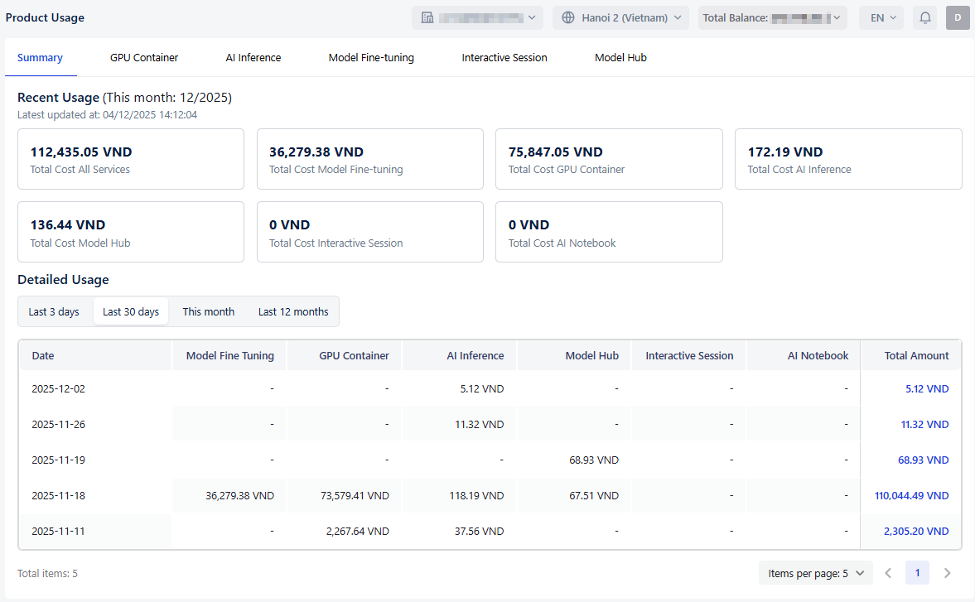
Product Usage: users can better manage budgets, optimize resource consumption, and make data-driven decisions with confidence.
A centralized interface that displays:
- Total cost of all services.
- Real-time updates for the current billing period.
- Cost breakdown by product category: GPU Container, AI Inference, Model Fine-Tuning, Model Hub, and Interactive Session.
Use case
- View total usage and spending across all FPT AI Factory services in a single, unified dashboard.
- Track detailed usage history (GPU Container, AI Inference, Model Fine-tuning, Interactive Session, Model Hub) by day, month, or year.
- Monitor real-time costs to prevent unexpected overspending and improve budget control.